Sand casting is an economical process for creating rough metal parts. Raw castings are then machined into finished products or components. Sand casting is the least expensive of all the casting processes, including die and investment casting. Normally, the sand casting is suitable to produce large sculptures which not very detailed.
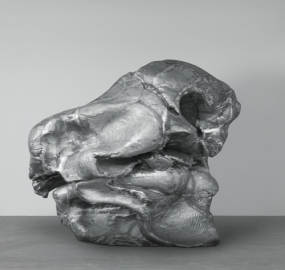
Mold Making
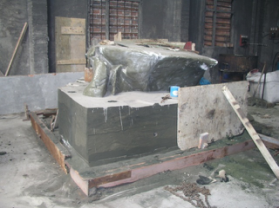
There are two main types of sand used for molding.Green sand and No bake resin sand.What we used to making mold is No bake resin sand,which also called self-hardening resin sand.After the formulation of sand mixture and the mold has been grounded & consolidated,pattern makers will put the sand into the cavity of shape,then they separate it when the sand become solidification.Normally,the pattern will be divided into not only two pieces but several pieces,which termed loose pieces.The upper part of pattern called cope,the bottom called drag.Pattern makers will also make aparting line toidentify cope and drag.
Sprues & runner system
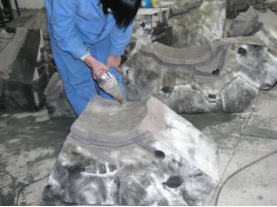
After separation of the pattern, patternmakers will dry the loose pieces. Then ready to setting runner system, also named gating system, normally, it contains pouring cup, runner, sprue and ingate, these channels will lead the molten metal pouring into the cavity. The patternmakers will brush refractory coating onto the surface of the pieces to make sure it won't break during pouring.
Mold Assemblying
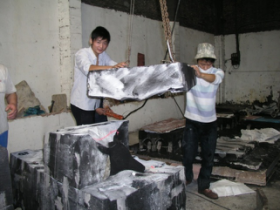
When the coating and runner system has done, then the patternmakers will stick a layer of foam board on the surface. This layer will determine the thickness of finished products. After that, these pieces will be reassembled to the original pattern. Then it will leave a mold cavity to lead into another step-pouring.
Pouring
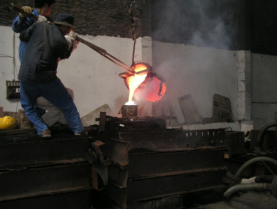
This is probably the most complicated process of sand casting, which needs consider lots of elements such like pouring time, pouring temperature and consolidation. And after the new pattern has grounded, workers will using steel, wood or rope to seal the pattern to avoid the pattern will expand and "leak fire". When the metal has been melted, it must be measure the temperature first, if it's not suitable for pouring, then must forbidden to do it.And also another step is remove the slag from the liquid. After everything is under control, then it can be pouring. Normally, the molten bronze's temperature can reach more than 1000 centigrade.
Chasing & Assemblying
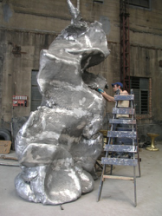
After it cooled and cleaned, and it's another time-consuming step-to make it detailed. It's a very professional technical process. Basically, it has two steps, welding and polishing. Welder first recreated the parts that was lost or damaged during pouring process. Then the polisher will chase it in detail to make it shining. These process is important in preparation for the application of patina.
Patina
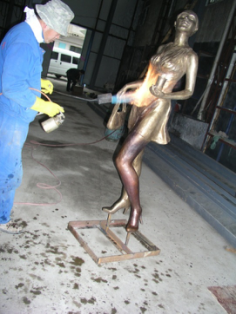
The various colors, patterns and textures obtained in the patina process are achieved through a combined application of chemicals and heat, augmented by hand stippling, or spraying with an air brush, and sealed with lacquer and waxes.