The Art of Lost Wax
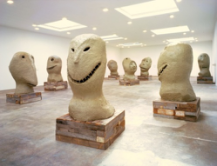
Lost wax casting has been around for thousands of years,yet few people understand how the process actually works.Although mechanization has facilitated the lost wax process of casting,
the procedure is basically the same as that used by our Country when we first developed the process in the 2nd millennium BC.
The Rubber Mold
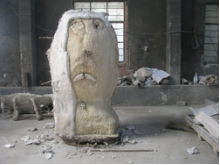
First the artist creates an original sculpture out of any number of media, including plaster, clay, FRP, wood or stone. This image is coated with a silicone rubber
molding material that makes two rubber mold halves (each rubber mold has a front and a back piece).It's been called as "Negative Mold".
The Wax Positive
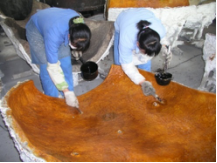
Once the Negative molds are done, the insides are coated with layers of wax. The halves are then bound together and wax poured inside to complete the wax image being created.
Once the wax has cooled, the mold is peeled away, yielding a wax image (the wax positive") duplicating the original sculpture.
This image must then be "touched -up" to remove any seam lines, scratches or other flaws, as well as to recreate any pattern or texturing that was lost or damaged when the wax was made.
The quality of the finished bronze relies on a clean, high quality mold and an impeccably recreated wax image that is as near to perfect as possible.
Spruing & Gating
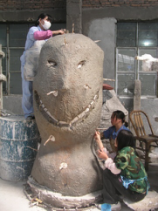
The next step, "Spruing & gating", is the application of a series of tubes and funnels that allow the molten metal to flow through to the bottom of the ceramic shell
and the hot gases to escape at the same time.
These sprues are created by attaching wax rods to the finished wax form at strategically spaced locations.
Ceramic Shell & Stuccoing
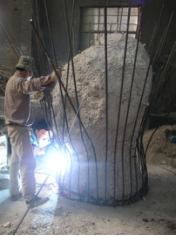
After the gating is completed each wax form is dipped in a liquid ceramic silica-sand compound so it is completely coated inside and out.
Then a refractory sand applied on it been called stuccoing.
This process is subsequently dipped 3 to 4 or more times over a period of several days until the desired shell thickness is achieved.
Lost Wax
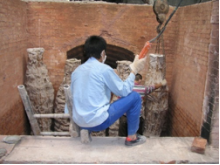
Once these ceramic shells have dried thoroughly the pieces are placed into an autoclave and the wax is melted out (hence the term "lost wax"), to be reclaimed and used again.
The shells are then cured in a kiln so they will withstand the temperature of the molten bronze being poured into them.
Pouring
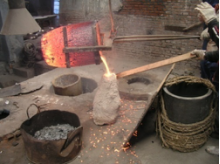
Bronze ingots are melted to a temperature of approximately 2000°F and poured into the cured ceramic shells.
As the sculpture cools the ceramic shell begins to pop away from the bronze. This shell will be completely broken away,
using a hammer and chisel, before the superfluous metal materials are cut away.
Texturing
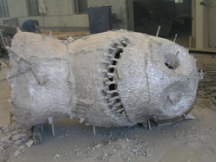
Finally, any texturing that was lost or damaged in the casting or welding process is recreated.The sculpture is then polished in preparation for application of the patina.
Patinas
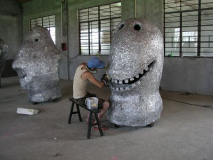
The different colored finishes that are possible on cast metal sculptures are called patinas.
The various colors, patterns and textures obtained in the patina process are achieved through a combined application of chemicals and heat,
augmented by hand stippling, or spraying with an air brush, and sealed with lacquer and waxes.